TASKS FOR TODAY:

Friday

1) Check the grammar review about rephrasing sentences, very short and very useful.
2) Structure Practice 5: Rephrasing (30 min.)
3) Vocabulary Practice 5 (25 min.)
4) Activity 11 (15 min.)
5) Listening Practice 9 (20 min.)
6) Reading Practice 5: Celebrating (30 min.)

Until now, you all have over 70/100 in your scores, but remember that when you are doing the actual exam, you have a time limit, try to finish these activities above a little faster than usual just to see how you do them and if there is any difference or not.


FCE Paper Based: Use of English

Part One: Open Cloze

Read the following extract from a brochure giving advice on taking an examination. For questions 1-12, type the word which best fits in each space. Use only one word in each space.

(0) to


Exam Tips
When the day comes give yourself plenty of time (0) ... do everything: have breakfast but don't drink (1) ... much; go to the toilet; arrive on time, but not too early or you will find yourself getting more and more nervous while you wait to start. Try not to talk (2) ... the exam before you go in.
In the exam, calm (3) ... down by breathing deeply and thinking positively. Read (4) ... exam questions carefully and underline all of the key instruction words (5) ... indicate how the questions should (6) ... answered. If possible start with the ones (7) ... can do easily to give you confidence. Remember what you've learnt from practising questions and doing mock exams previously and plan your use of time. Don't panic (8) ... everyone around you seems to start writing furiously straight away and don't be tempted to follow their example.
Finally, after the exam, don't join in a discussion about (9) ... everyone else did, (10) ... you want to frighten yourself, and drain your self-confidence for the next exam. Above (11) ..., remember that exams are not designed to catch you out, (12) ... to find out what you know, what you understand and what you can do.

Part Two: 'Key' Word Transformation

For questions 1-8, complete the second sentence so that it has a similar meaning to the first sentence, using the word given. Do not change the word given. You must use between two and five words, including the word given.

1. I want to go to university this year.
INTERESTED
I ........................................ to university this year.


2. "Have you been on holiday recently, Jane?" asked Tony.
BEEN
Tony asked Jane ........................................ on holiday recently.
3. I was too tired to go to the party.
THAT
I was ........................................ I couldn't go to the party.


4. There's no point asking Lynda to help as she's really busy.
WASTE
It's ........................................ asking Lynda to help as she's really busy.


5. The union claims its members will only return to work if the company agrees to a meeting.
NOT
The union claims its members will ....................................... the company agrees to a meeting.


6. I'm sure it was Ana I saw in town as I recognised her coat.
MUST
It ........................................ Ana I saw in town as I recognised her coat.


7. We demanded to see the hotel manager to make our complaint.
SEEING
We ........................................ the hotel manager to make our complaint.


8. The boss wouldn't object to you going early today.
OBJECTION
The boss would not ........................................ you going early today.


Part Three: Word Formation

Read the text and then write the correct form of the word in CAPITALS to complete the gaps. There is an example at the beginning.

Example: 0 natural

Food Production

In the not-too-distant past farm animals were able to
live (0) ... lives in what we would now termNATURE
'free-range' conditions. Such farming methods however,
(were not able to supply the rapidly growing (1) ...POPULATE
of the world and the increasing demands on food
(2) ... In order to cope with this rising demand, factoryCONSUME
farming methods were introduced along with the (3) ...DEVELOP
of genetically engineered (4) ... hormones, whichGROW
resulted in a massive increase in food (5) ...PRODUCE
However, these developments in the use of factory
farming and drug (6) ... have led to a widespreadTREAT
feeling that animals are being caused a lot of distress
and that the quality of the food itself suffers as a
consequence. Certainly, many people (7) ... with the ideaAGREE
of keeping animals in one building for their entire (8) ...EXIST
and argue that more emphasis should be given to (9) ...ALTERNATE
farming methods. A growing number of people are
choosing to eat organic food, supporting farmers who use
free-range methods, a system which has proved to be
both (10) ... and more humane.ECONOMY
Part Four: Multiple Choice Cloze

For Questions 1-12, read the text below and decide which answer A, B, C or D best fits each space.  

Example: (0) A situation B place C position D site


Environmental Concerns
Earth is the only (0) ... we know of in the universe that can support human life. (1) ... human activities are making the planet less fit to live on. As the western world (2) ... on consuming two-thirds of the world's resources while half of the world's population do so (3) ... to stay alive we are rapidly destroying the (4) ... resource we have by which all people can survive and prosper. Everywhere fertile soil is (5) ... built on or washed into the sea. Renewable resources are exploited so much that they will never be able to recover (6) ... We discharge pollutants into the atmosphere without any thought of the consequences. As a (7) ... the planet's ability to support people is being (8) ... at the very time when rising human numbers and consumption are (9) ... increasingly heavy demands on it.
The Earth's (10) ... resources are there for us to use. We need food, water, air, energy, medicines, warmth, shelter and minerals to (11) ... us fed, comfortable, healthy and active. If we are sensible in how we use the resources they will (12) ... indefinitely. But if we use them wastefully and excessively they will soon run out and everyone will suffer.


1  A    Although
B  Still  C  YetD   Despite
2
A
 continues
B
repeatsC
carriesD
 follows
3
A
 already
B
justC
forD
 entirely
4
A
 alone
B
individualC
loneD
 only
5
A
 sooner
B
neitherC
eitherD
 rather
6
A
 quite
B
greatlyC
utterlyD
 completely
7
A
 development
B
result C
reactionD
 product
8
A
 stopped
B
narrowedC
reduced D
 cut
9
A
 doing
B
havingC
takingD
 making
10 A  natural B realC livingD  genuine
11 A  hold B maintainC stay D  keep
12 A  last B standC goD  remain


FCE paper based: Reading

Part One: Multiple Choice

Instructions
You are going to read an extract from a writer's journal. For Questions 1-8, choose the correct answer A, B, C or D.


Extract
Six months ago I made a rash promise. The leader of the youth club in our village had rung me in March saying, "We're thinking of running a children's playscheme for a day in October half-term. Would you be prepared to help?" My response was "Sure, why not?" In truth I was a little flattered to be asked, even though working as a care assistant with old people hardly qualified me for the role. Still, I duly put the date in my diary and of course I forgot all about it. I don't know if you've noticed this but time has a habit of speeding along faster than a police car chasing a robber and, before I knew it, the dreaded day was dawning.
I arrived at the youth centre that morning feeling full of trepidation. There was a gang of 12 helpers including me, split into pairs, and each pair had been allocated a particular age group. Mine was the 10 to 11 year olds. Even with the planning meeting I had attended the week before, I worried about whether I was up to the task. Why hadn't I read through the copious lesson plans we were given beforehand? And wasn't the average 10-year-old more interested in the latest electronic game than making things with paper and glue?
All too quickly the children began arriving. The look of relief on parents' faces as they handed their offspring over to us was almost comical. A handful of the children were already members of the club but the other forty five or so were from the local primary schools. One or two looked tearful but the rest were in high spirits. Again I asked myself why I had elected to spend a day with all these 'little monsters' especially when I have two all of my own to contend with!
I needn't have worried of course as it turned out to be a marvellous day. We watched entertaining dvd clips, learned 'action' songs, made clay pyramids, kneaded bread, decorated biscuits, played memory games and spent some time in quiet reflection. I say 'we' because I rediscovered my inner child and joined in all the activities with glee.
The particular highlight for me was a rousing rendition of "He's got the whole world in his hands" in the closing part of the day. The children already knew the words and actions off by heart and sang so loudly it was almost enough to bring the roof down. It's difficult to explain those moments; only that the body tingles with the pleasure of having witnessed something so magical.

Of course there were also moments of great poignancy. I found it difficult to stop thinking of one little girl, who mentioned oh-so-casually that her mum was in hospital and would be there for a long time. It's easy for us adults to idealise childhood and forget that some children have their own burden of anxieties and concerns. When I got home utterly exhausted, still with modelling clay under my fingernails, I reflected on what a privilege it had been.
There was one disappointment for the children and that was that the playscheme was only running for a day, and not the whole week. As I said farewell to my group, one of the children turned and said, "Can we do it again in the next holiday, Miss?" My response was, "Sure, why not?"

1. When the offer of the job was made the writer
A. felt she had made a mistake to agree.
B. thought she had appropriate experience for the job.
C. believed she shouldn't have been asked.
D. gave the impression she wasn't sure about accepting the job.


2. When the day arrived the writer was surprised
A. that the day had come round so quickly.
B. because she'd forgotten to write down the date.
C. because she witnessed a car chase on the way.
D. that she woke up at dawn.


3. When the writer arrived to start her job she
A. put the children into pairs.
B. realised she should have done more preparation.
C. felt confident she could deal with 10 and 11 year olds.
D. saw the children had brought their own electronic games to play with. 


4. According to the writer, the parents were
A. happy to stay with their children all day.
B. worried about children from the other schools.
C. nervous that their children might not behave themselves.
D. glad to leave their children.


5. The writer needn't have worried because
A. the children were quiet during the day.
B. the children weren't doing messy activities.
C. she had fun herself.
D. the time passed quickly.


6. The writer's best moment
A. occurred in the middle of the day.
B. took her by surprise.
C. was hard to put into words.
D. was when the day was over.


7. According to the writer, adults
A. think that being a child is a privilege.
B. sometimes forget that children have worries too.
C. are usually exhausted by bringing up their children.
D. don't have a stressful life.


8. What is the writer's attitude by the end of the day?
A. She could imagine doing the job again next time.
B. She was sad to say good bye to the chidlren.
C. She was disappointed with the experience.
D. She hopes the playscheme will be longer in future.


Part Two: Gapped Text

Instructions
You are going to read a magazine article about John Prince, a dancer, dance teacher and choreographer. Seven sentences have been removed from the article on the left. Choose the most suitable sentence from the list A-H on the right for each part (1-7) of the article. There is one extra sentence which you do not need to use.


Career success in the arts

John Prince, famous dancer and choreographer, gives advice on how to succeed in a career in the arts.

I asked John how he got started and what requirements there are. "Well, to be a professional dancer it's useful to have had acting lessons or some background in drama. If you want to succeed in musical theatre you have to have a good singing voice as well. When you approach an agent you should take a portfolio with your CV, your statistics sheet and some good photos and reviews of past performances. You'll need dance clothes, ballet shoes, tap shoes, and even roller skates depending on what kind of show you are going to go for."

1 

"Of course, you need to be extremely fit if you want to be a professional dancer. I dance or move about for about six hours a day. There are great health benefits to being a dancer. I can eat a lot of pasta without gaining weight because dancing increases your metabolism so much."
2 

John has a very busy schedule in the next few months. He took time out to speak to me today from the making of a pop video to promote N-ergy's latest record. "I choreographed the dance routine for the boys and they only had 2 days in which to learn it! I am going to be working on a video for another well known band - but that's top secret. Next month I'll be touring Spain in a production of a musical that was written by a friend of mine, Michaela Evans.
3 
As for the future, I've come to realise that I would never be content to be just a chorus dancer - I'm too much of an individual for that. Like all artists I'd love to become a household name by writing and choreographing my own musicals."

John was born in Jamaica to a Jamaican father and a Scottish mother but the family emigrated to England 20 years ago. "I have a little sister I adore, who is also training to be a dancer." How does it feel to have someone else following in your footsteps?
4 

Has he much more to learn, I wondered. "I've spent an incredible amount of my life training to get where I am. I went to college for two years in England, I trained for six months in Paris and about eight months in America. But you never really stop training or learning your art."
5 

So, would you say it's been plain sailing? "I feel I've been lucky to a degree; many people hit problems breaking into the arts. It can be a vicious circle really. You can't become a member of Equity, which is the actors' and dancers' union, without good contracts and you can't get good contracts without being a member of Equity. My advice to people who want to get into the arts would be to go out into the world, and try everything else first.
6 

What has a dance career done for you as a person? "Thanks to dancing, I've visited and performed in 23 countries so far. This has opened my eyes to the world, and I've been able to understand issues like racism and inequality from a wider perspective.
7 
"So all in all I'm really happy to be a dancer!"
A It's fine, but I try not to give out too much advice as it gets irritating!

B And if nothing you like comes out of it, then come back and be an actor or dancer.

C Without a strict daily timetable like this you find yourself wasting too much time.

D After that it's back to England to start a new term of dance classes.

E Hopefully this has enabled me to become a better and more tolerant person as a result.

F When it comes to coping with stress, I find that exercise helps me to cope with my problems, so I stay in good shape mentally as well.

G Like any profession where you're always travelling, you tend to acquire something new almost every day.

H Being fully equipped with all this stuff beforehand makes it easier when you go for auditions.

Part Three: Multiple Matching

You are going to read a selection of letters from a driving magazine. For questions 1-15, choose from the people (A-E). The people may be chosen more than once.


Your Letters

This month we feature your early driving experiences:
A
I'd been taking lessons for a year before I passed my driving test at the age of eighteen, but my dad never gave me any help. Even after I'd passed he never let me use the car. So I used to take my dad's keys before leaving the apartment block where we lived and would run round to the car park at the back where my father left the car at night. He hardly ever used the car after getting in from work. I used to go and see my girlfriend or just drive around and then come back and leave the car in exactly the same place. One night though, I got back at around ten thirty only to find there were no parking spaces left. I suppose because I went in and told my dad the truth straight away he was quite good about it. Although he did stop my allowance for four weeks.
Terry

B
My most unfortunate driving experience happened ages ago, before I'd actually passed my driving test. My girlfriend's father used to let her borrow his car whenever we were going to the cinema or something. Anyway, I'd been thinking about learning to drive and I persuaded her to let me have a go. We took the car down to the beach on the sand where no one could see us and she let me take the wheel. We were having such fun that we didn't notice the tide was coming in until the car was actually swimming in the water. We had to leave the car where it was and catch the bus back to tell her dad. By the time the three of us returned, the car was almost covered in water. Needless to say, her father wasn't too pleased. The funny thing is her dad ended up selling me the car after I passed my test.
Carl

C
I was teaching my mum to drive and we were coming down a rather narrow road which had cars parked on both sides. Suddenly, from nowhere there was a young man on a bike coming towards us. Mum slammed the brakes on but he crashed into us, landed on the car and then rolled off. My mother and I both jumped out of the car to see if he was all right. Fortunately, he stood up and said he was OK, just a little shaken. My mum offered to give him some money for the repair of the bike, and then an old lady came along. When she saw what had happened, she began shouting at my mother, saying she must have been driving too fast and that it was a bad example to set her young daughter. Poor old mum didn't say a word and I had to explain that she was still learning to drive.
Sarah

D
My advice about learning to drive would be to have proper lessons from a qualified instructor and never to let a friend or family member try to teach you. It's a guaranteed way to spoil a good relationship. Every Sunday, when the traffic was quieter, my father would pick me up and take me for a drive along the streets of our hometown and give me a lecture on how to drive, explaining everything he was doing and why. Eventually it was my turn to have a go. My dad was so nervous that he panicked before I'd even started up the engine. He used to shout at the slightest mistake, and when the lesson was finally over he'd come home and have a large glass of whisky to calm down.
Karen

E
I didn't start learning to drive until I was twenty one. I'd spent lots of money on lessons but I was a terrible driver, I must admit. The first time I took my driving test nobody expected me to pass. But after failing another four times the pressure was really on. I took my test for a sixth time and failed yet again, but I was too embarrassed to admit it to my family, so I just pretended that I'd passed after all. My family were delighted and my father went out and bought me a car the next day. I didn't know what to do so I just got in and drove. I continued to drive - illegally - for three months. Fortunately I was never stopped by the police and the next time I took my driving test I passed.
Mike


Which person('s)

1) father was accused of driving dangerously?

2) bought a car?

3) drove his girlfriend’s dad’s car?

4) drove alone without a license?

5) had to defend one of their parents?

6) drove their father’s car without permission?

7) was teaching someone to drive?

8) paid for driving lessons?

9) had no driving instruction from their father?

10) was punished for their actions?

11) was given driving lessons by their father?

12) was considering taking driving lessons?

13) advises against being taught to drive by a friend or family member?

14) was given a treat for passing their test?

15) used to make their father nervous? 

About the Use of English section of the FCE

Use of English paper is a word formation exercise. In this exercise you must complete a text by forming words. You form each word from one that is provided. The first word is always given.
Look at this basic example:
 
Before  to our school, each child's
ADMIT
intelligence is measured by a .
PSYCHOLOGY
Intelligence is a gift which must
PRICE
have to develop.
ENCOURAGE
 
To do this exercise successfully you should:
Decide what kind of word is needed in the gap (noun, verb, adjective or adverb).
Decide what part of the word is needed, that is, a singular or plural noun, the correct tense or part of a verb.
Check whether the sense suggests a negative prefix (e.g. un–, dis–) or suffix (e.g. –less).
If you add a suffix, check whether any other spelling change is needed, e.g. beauty >> beautiful.
SUMMARY OF THE 'USE OF ENGLISH' PAPER
This paper tests your knowledge of English grammar and vocabulary. It has five parts:
Part 1:  Gap-filling (multiple choice)
Part 2:  Gap-filling (open)
Part 3:  Rewriting sentences
Part 4:  Error correction
Part 5:  Word formation
TIMING
You have 1 hour 15 minutes to do the whole paper, so that is roughly 15 minutes for each part. But you will probably find that you need more time for some parts than others.
Make sure you leave about ten minutes at the end to check all your answers thoroughly. You will have to write your answers on a special answer .sheet.
FINAL ADVICE
Try to revise several activities before the exam for practice in using your time wisely. Do not panic if you don't understand everything the first time, and always read the instructions carefully.

Acerca del FCE

¿Qué es el FCE?

El Cambridge First Certificate in English (FCE) es el tercer nivel de los exámenes de Cambridge de Inglés para Hablantes de Otros Idiomas (ESOL). Es un examen de nivel intermedio avanzado y reconoce la habilidad de manejar con seguridad una variedad de comunicaciones escritas y orales.

Todos los candidatos reciben un reporte con los resultados en donde se muestra su desempeño en cada una de las cinco partes del examen. Los candidatos exitosos reciben un certificado de University of Cambridge ESOL Examinations. Este certificado es reconocido por universidades y empresas en muchos países.

El FCE tiene cinco partes:
1.  READING (Lectura). 1 hora;
2.  USE OF ENGLISH (Uso de inglés): 45 minutos;
3.  LISTENING (Comprensión auditiva): 40 minutos;
4.  WRITING (Escritura): 1 hora 20 minutos;
5.  SPEAKING (Conversación): 14 minutos.

Para nuestro examen final FCE prepararás las partes 1, 2 y 3 exclusivamente. Si tu intención es presentarte al examen oficial deberás preparar las partes 4 y 5 por tu cuenta.
¿Quién debe presentar el FCE?

El FCE está diseñado para aquellas personas cuyo manejo del inglés es el adecuado 

para propósitos prácticos cotidianos que incluyen negocios y estudio. Los candidatos 
exitosos tendrán un amplio conocimiento de vocabulario y deben estar en capacidad de 
construir un argumento y utilizar estilos apropiados de comunicación para una variedad 
de situaciones. También necesitan mostrar conocimiento de registro y de las convenciones 
de cortesía y grados de formalidad como se expresan a través del idioma.

El FCE lo toman alrededor de 270.000 personas cada año en más de 100 países. 

Es una calificación valiosa para cualquier persona que quiera estudiar o trabajar en el 
exterior o desarrollar una carrera que requiera habilidades del idioma incluyendo 
negocios, medicina, ingeniería y muchas otras profesiones. También es una preparación 
útil para los exámenes de un nivel más alto como el Cambridge Certificate in Advanced 
English (CAE) y el Certificate of Proficiency in English (CPE).
¿Por qué elegir el FCE?

El FCE es reconocido por muchas universidades y otras instituciones educativas como prueba 

de un nivel intermedio avanzado de inglés. Estas instituciones lo aceptan como parte de
 sus requisitos de ingreso.

Debido a que los exámenes se basan en tareas reales, un certificado de FCE es una 

ventaja importante para cualquiera que desee trabajar o estudiar en el exterior o en 
negocios internacionales. Empresas en todo el mundo reconocen el FCE. Este indica la 
habilidad suficiente en inglés para utilizarlo en trabajos administrativos, secretariales y 
gerenciales en muchas industrias, en particular en la turística donde se requiere contacto 
con angloparlantes. Los candidatos exitosos tienen la habilidad de manejar cartas,
 llamadas telefónicas de rutina, algunos cursos de entrenamiento no académicos, además 
de libros y artículos simples.

FCE Overview

FCE Introduction

The Cambridge First Certificate in English examination, or FCE for short, is a qualification in English as a Foreign Language awarded by Cambridge ESOL. The current version of the exam was recently introduced for December 2008 and is sometimes referred to as the 'revised FCE'. It is a popular exam with over 250,000 candidates per year.
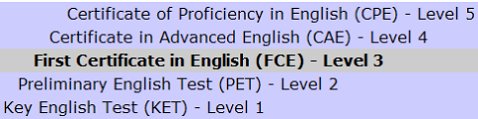
FCE is one of five 'Main Suite' examinations offered by Cambridge ESOL. The level of FCE is described as Intermediate. The table below shows how FCE fits into the Cambridge ESOL framework:
Cambridge FCE in main suite
Because FCE is internationally recognised, people choose to take the exam for work purposes, study purposes or just for their own interest.
Adapted from the 'FCE Handbook', which is available to order from Cambridge ESOL.

Parts:

FCE Paper 1 Reading:

Time allowed: 1 hour

PartTask typeTests ability toQuestions
1. Multiple choiceA text followed by multiple-choice questions with four options: A, B, C or D.understand detail, opinion, gist, attitiude, meaning, tone, purpose and main ideas8
2. Gapped textA text with missing sentences; candidates choose the sentence order from a jumbled list.understand text organisation (how language achieves cohesion and coherence) 7
3. Multiple matchingOne or several texts with prompt questions; candidates match the prompt to the relevant section of the text(s).understand specific information, detail, opinion and attitude15

FCE Paper 2 Writing:

Time allowed: 1 hour 20 minutes

PartTask typeTests ability toWord length
1. Compulsory taskRead input information (including adverts, extracts from letters, emails, schedules, etc. of up to 160 words) and write a Letter or Email.make appropriate use of the input, write for a specific purpose and audience, with accurate language control120-150
2. Choice of one out of five tasks.2: (Questions 2-4) Candidates write one of the following: Article, Essay, Letter, Report, Review or Story.
write for a specific purpose and audience, with accurate language control120-180

FCE Paper 3 Use of English:

Time allowed: 45 minutes

PartTask typeTask focusQuestions
1. Multiple choiceA text with twelve gaps. Candidates choose the correct missing words by answering twelve multiple-choice questions with four options.Collocation, phrasal verbs, idioms, phrases12
2. Open clozeA text with twelve gaps. Candidates fill in the missing words.Grammatical items12
3. Word formationA text with ten gaps. Candidates form the missing words from the given stem words.Prefixes and suffixes, compound words10
4. Key word transformationsEight separate questions, each containing a lead-in sentence, followed by a 'key word' and a second (gapped) sentence. Candidates complete the second sentence in two to five words, and must include the 'key word'.Grammar and vocabulary8

FCE Paper 4 Listening:

Time allowed: Approximately 40 minutes

PartTask typeTests ability toQuestions
1. Multiple ChoiceA series of extracts with one or more speakers lasting around 30 seconds each. Candidates answer one multiple choice question per extract, each with three options: A, B or C.pick out general meaning specific information, understand attitude and/or events from the text.8
2. Sentence completionA three-minute monologue or dialogue. Candidates fill in the gaps to complete the sentences.pick out general meaning or specific information from the text.10
3. Multiple matchingA series of related monologues lasting around 30 seconds each. Candidates match the extract to the correct option from a list of six.pick out general meaning specific information, understand attitude and/or events from the text.5
4. Multiple choiceA three-minute monologue or dialogue. Candidates answer multiple choice questions with 3 options: A, B or C.pick out general meaning or specific information from the text.7

FCE Paper 5 Speaking:

Time allowed: 14 minutes

PartTask typeTests ability toTime
1. Conversation between Interlocutor and each candidateCandidates take it in turns to answer spoken questions that focus on interactional and social language.give personal information and talk about past, present and future experiences3 minutes
2. Individual 'long turn' (1 minute) and response from second candidate (20 seconds)Each candidate is given a pair of photographs and asked to talk about them, using the prompt questions on the page. The second candidate gives a brief response. Tasks focus on: comparing, describing and expressing opinions.speak for a long turn using appropriate language1 minute/20 seconds
3. Two-way conversation between candidatesCandidates are given spoken instructions, along with visual and written prompts, and work on a decision-making task. The focus is on sustaining the interaction by: sharing ideas, expressing and justifying opinions, agreeing and/or disagreeing, suggesting, speculating, evaluating and negotiating to reach a decision.give opinions, agree & disagree, make suggestions etc; take turns3 minutes
4. Discussion related to the task in Part 3Candidates answer spoken questions that focus on: expressing and justifying opinions, agreeing and/or disagreeing.give and justify opinions, agree & disagree, take turns and explore topics4 minutes

ABOUT THE FIRST CERTIFICATE EXAM

The First Certificate in English is one of the examinations available from University of Cambridge ESOL Examinations in England. Its possession proves one's adequacy in the English language, and its successful completion means that one is able to interact socially efficiently. The FCE examination falls in the grade B2 to the Common European Framework of Reference for Languages. It is similar to TOEFL as it is made for people who learn English as a Foreign Language, the advantage is that it's expiration date is throughout life.

The B2 grade of the CEFRL means that the person has an upper-intermediate use of the language, and is evaluated in these terms:

 - Can understand the main ideas of complex text on both concrete and abstract topics, including technical discussions in his/her field of specialisation.

- Can interact with a degree of fluency and spontaneity that makes regular interaction with native speakers quite possible without strain for either party.

- Can produce clear, detailed text on a wide range of subjects and explain a viewpoint on a topical issue giving the advantages and disadvantages of various options.

The exam consists of the following parts:


The best you can do to pass this exam is practice as much as possible before the day of the exam. When that day arrives, it is important to be focused and to read and understand all the questions. It is a 4-hour exam, so usually people lose concentration in the last part, that is why we are going to practice a lot in this class in order to achieve the best level for the day. Feel free to ask me any questions.